A Response From The Guests To The United Wards Club
Professor Michael Mainelli, Guildhall, 16 March 2026
President, Past President, Past Past Presidents, Chairmen, Masters, Ward Club members, distinguished guests all:
My thanks to Senior Vice President Stephen Willis Blue Guiding us through us guests.
If I were President Trump, I would be coming here, to the United Awards Club – for a bargain – my Oscar, Grammy, Emmy, BAFTA, FIFA, and Nobel prizes all at once. Elisabeth woke me up from dreaming about my acceptance speech and suggested tonight’s talk title, “What’s In A Ward?” in the singular.
When I arrived in the City in the 1980s, I had absolutely no idea “What’s In A Ward?” I assumed it was either some very sick people in beds attached to a hospital corridor or a school section name, something-to-be-published-a-decade-later in Harry Potter. In fact, the hospital corridor theory may have led me to refer to some of you Masters as Matrons from time to time.
Then I asked an older partner in my firm why I had a voter’s card for the City when I lived in Bayswater. He was one of those magnificent City figures who speaks entirely in subordinate clauses and knows where every body is buried, too often literally. He explained that the City of London is the world’s oldest continuous democratic workers’ and residents’ cooperative. He described the City resting on three legs — the Corporation of London, the livery movement, and the wards. Like a stool. A very old, very distinguished stool. One that has outlasted every empire, every plague, every financial crisis, and probably the coming of fusion power and quantum computing.
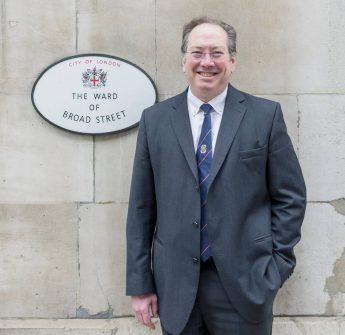
I felt immediately that I should have known this. I also felt that I needed a drink. Fortunately, the City was the right place on both counts. Ever since then I’ve been proud to be a member of ward clubs, a former Chairman of Broad Street Ward Club, hanging on as President today, and delighted to be a member of Lime Street & Cornhill and Farringdon as well. Elisabeth is a proud member of Tower Ward.
Ward clubs themselves rest on three legs — commerce, community, and charity. Which makes them, structurally speaking, identical to the City’s stool, suggesting that either the metaphor is very apt or that whoever designed the City’s institutions was a Furniture Maker.
On commerce, a vibrant local association is a benefit to everyone, helping the local element of all businesses, from small shops and traders to globe-spanning firms of lawyers and accountants, everyone needs to bind with their neighbourhood. On community, informing, networking, and stitching together the fellowship needed to make society work together is worth celebrating. On charity, our wards’ deep and generous commitment to philanthropy is widely-recognised, and your City thanks you.
Wards date back to at least the ninth century, making them roughly contemporary with the concept of organised government itself. They may have existed since the seventh century when Bishop Earconwald first ordered repairs to the Roman walls as Londoners recolonise the City from Lundenwic in the Strand. They set up so many churches in one square mile, 112 of them, that I sometimes think incense burning begat climate change.
Each ward had its own church, beadle, wardmote, and local administration. The City has held proper elections for two Sheriffs over the wards since the seventh century. After Sheriffs came Aldermen in the eighth century.
By the millennium, the first millennium that is, wards were electing their own representatives, collecting their own levies, and generally getting on with the business of civilisation while the rest of the country was still arguing about who owned which pig in some doomy gloomy book. Then came Common Councillors, and finally an exquisite new position built for people with inflated self-importance, the Lord Mayoralty, in 1189AD.
Wards are not places you stumble across. Nobody has ever said “Quick, meet me in Bassishaw” unless they were either lost, or tremendously well-informed. And the difference between lost or tremendously well-informed, in the City is often just a turn into an unknown alley.
In the High Middle Ages (c. 1000–1200), London was described by William FitzStephen during King Stephen’s reign as having a large, militaristic population, with 20,000 horsemen and 60,000 foot soldiers. Contemporaries recognized Londoners as unusually disciplined, effective fighters rather than passive urban inhabitants. A thousand years before Millwall FC Londoners chanted, “No one likes us, we don’t care!” Visitors remember Londoners Beating the Bounds – a great tradition of walking ward boundaries and hitting markers with sticks. If boys couldn’t remember the markers then they too were hit with sticks. This sounds barbaric. It absolutely is. It is also, I submit, a more reliable method of geographic education than anything currently offered at GCSE.
Today, it’s more – “hey I’m a voter, you’re a voter, let’s have lunch” club. Perhaps Labour, the Conservatives, the LibDems, and others have something to learn. But it wasn’t always friendly. Each ward had its own militia. Yes — militia. The ward could raise armed men. I mention this purely for information and not as a suggestion for how we might handle future planning applications. Though if I were Coleman Street or Bishopsgate I might worry about Broad Street clawing back territory, moving tanks to our western and eastern fronts.
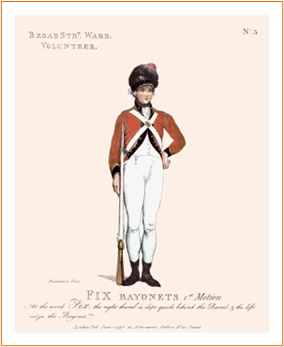
My beautiful assistant, Elisabeth, will now show you, in boxing ring rounds style (though perhaps without the bare mid-riff), Broad Street’s militia from 1798 as an example. This leads me to point out that Candlewick’s claim to be the oldest, founded 1670, reconstituted 1739, while accurate, is probably matched by almost everyone here is some form of older, quite organised and formal, ward governance.
You move from a great President, Chris Edge, to a new President, Mary Hardy, both of whom I have the fortune of knowing well from the World Traders. I was grateful that as Lord Mayor I was able to assemble the wards together at Mansion House for the first time, and thrilled with the enthusiasm which the United Wards Club, led by Chris Edge and Mary Hardy, has shown to keep us all working together even more effectively, and putting so much energy into forming the Wards Club Forum. At that time two years ago, I encouraged us to adopt an adjective for our wards – Broad Street being the finest. But looking at a list of 25 wards I realise that ‘H’ falls alphabetically to Broad Street. Confused by what I just said? You’ll see.
Some wards are named after people; others for trades; two recall lost rivers — one river is so lost that some historians think it never existed. Bizarrely, my first trivia clue this evening, three-fifths of the Wards, 60%, 15, begin with an A, B or C, and we’ll come to the fact in a moment that six contain the word ‘gate’.
Isn’t it about time we sorted out our ward adjectives? Name checks are evocative and get your audience onside, yet sometimes become etymologically provocative, so here we go with my Harry Potter Sorting Hat adjectives. You are free to stand, if able, as your ward is called in alphabetical order:
- Aldersgate: first recorded around 1000 AD as Ealdredesgate; the ACE-EST ward of the City of London;
- Aldgate: old-gate, all-gate, el-gate, Ale-gate, ele-gate – string all five versions into – an old gateway for all foreign ale and oil drinkers; BOUNTIFUL;
- Bassishaw: not a Shirley Bassey cover group but the 13th century Basing family; CHOICEST;
- Billingsgate: fourth century BC king Belinus’s water gate, though like a hallucinating AI, Geoffrey of Monmouth is the source; DASHINGEST;
- Bishopsgate: this time there is a band, the Beatles – “The celebrated Mister K., Performs his feat on Saturday at Bishopsgate” – Bishop Earconwald gets his name check here; EXCELLENT;
- Bread Street: obviously where Bakers were once two-a-penny; FINEST;
- Bridge and Bridge Without: a Pilates exercise connected with London Bridge – or the City’s bridgehead in Southwark up until 1978 – trivia: contains the entire span of London Bridge; GRANDEST;
- Broad Street: wider than the rest, before we worshipped the god Ozempic; HOSPITABLE (HANDSOMEST, HEARTIEST – we may not get off ‘H’);
- Candlewick: yes candle district, but ‘wick’ does not refer to a burning bit of candle, rather ‘candlewright’. Candelwrichstrete gives us Cannon Street; INSPIRATIONAL;
- Castle Baynard: a Norman fortress demolished in 1213, western mirror of the Tower of London. Trivia: contains the full span of Blackfriars Bridge; JOLLIEST;
- Cheap: ‘chepe’, the market before inflation; KINDEST;
- Coleman Street: charcoal burners before climate change; LUCKIEST;
- Cordwainer: a worker in Spanish leather from Cordova; MERRIEST;
- Cornhill: a corn market from at least the 12th century; NICEST’; with Lime Street;
- Cripplegate: from the Anglo-Saxon word crypel or crepel, meaning a covered way, burrow, or underground passage – or for the sick; OUTSTANDING;
- Dowgate: dou or dwr, water, an ancient “water-gate”; PRODIGIOUS; with Vintry;
- Farringdon: we should bring back the 12th and 13th centuries common practice of referring to wards by the name of their Aldermen. After Sir Nicholas de Faringdon, who was appointed Lord Mayor of London for “as long as it shall please him” by King Edward II in 1308; so Within, QUAINTEST;
- split Within & Without in 1394; so Without; RADIANT;
- Langbourn: a long-lost, historic stream or “bourne” that may or may not have existed; SUMPTUOUS;
- Lime Street: not trees but limestone burners; TERRIFIC;
- Portsoken: “soke of the English Knightengild,” a “liberty” given by the King to 13 knights outside the Port of London; UNIQUE (EST (sic));
- Queenhithe: Queen Matilda’s, wife of King Henry I, landing place in the early 12th century; VIVACIOUS;
- Tower: from the Anglo-Saxon, “duh”; WONDERFUL;
- Vintry: wine landing; XQUISITE or XENIAL or XCEPTIONAL American style;
- Walbrook – “brook of the Welsh” for Shirley Bassey fans (or “brook of the foreigners”), for native Britons residing there during the Saxon period; YEOMANLY;
Ward clubs are, in modern parlance, gateway drugs. All 22 of them, not just the six with gate in the name. They are the tobacco that moves you on to the cocaine of the livery, or the marijuana that moves you on to the heroin of high office. Every year at Broad Street’s annual lunch I define our ward club as “an historical drinking society for voters, residents, and City addicts”.
You join a ward club. Each month an indoctrinating newsletter encourages you to meet people at events. You discover the livery companies. Three years later you find yourself wearing a gown you don’t entirely understand, processing somewhere historic for reasons that are opaque and may shake the foundations of historical accuracy, and feeling in your bones — absolutely correctly — that this is magnificent.
Which brings me to the United Wards Club — the body that does what all grand federal institutions do: hold the family together when individual members are busy arguing, coordinates where coordination is essential, and reminds us all that we are, beneath our ward rivalries and our livery distinctions, part of something unified and remarkable.
I would encourage us to accelerate our drug dealing & distribution network – can we go from some 6,000 ward club members to rival the livery movement’s nearly 50,000? We have a target market of 676,000 workers and 8,000 residents. Can we recruit, retain, relapse – but never reform – our members into the deeper opiates of our City community?
Wards are not relics. They are living, functioning, democratic miracles hiding in plain sight inside the world’s capital city. And the United Wards Club is their common heartbeat. Thank you for all you do to promote our City’s virtues and values through education and hospitality.
The City is always about continuity and change, conducting our rituals while seeking to renew our relevance. We’ve been here before; we always come back better again. With your help our future ranges from ACE to ZESTY, and ZESTY awaits our 26th ward. Westminster watch out.
Thank you.
Now may I ask everyone to rise and drink a ‘Hardy’ toast to the United Wards Club, may if flourish root & branch, coupled with the name of the President, Mary Hardy!