
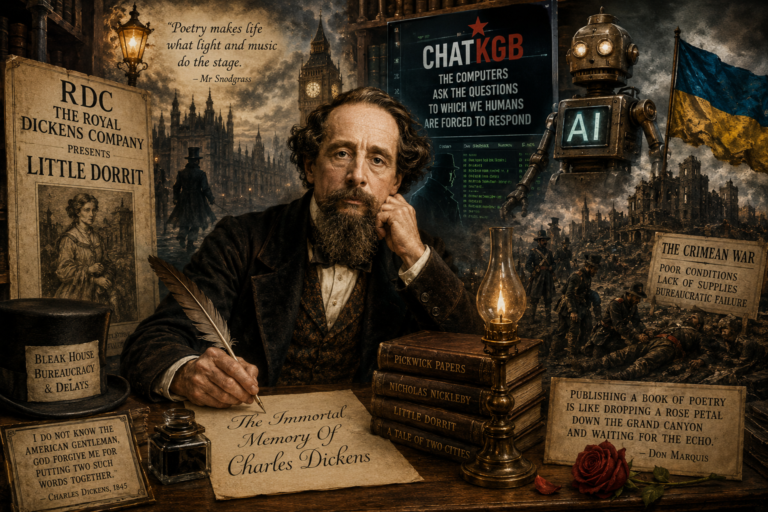
TO THE IMMORTAL MEMORY
Alderman Professor Michael Mainelli
Friday, 28 July 2023
The Garrick Club
Annual Conference of the Dickens Fellowship: Barnard’s Inn, London (26-29 July 2023)
Chairman, Distinguished Guests, Ladies & Gentlemen,
Although there is a wealth of Dickensian material to mine, I suspect that this assembly of enthusiasts has mined it thoroughly. At first I read “Great Expectations”, but the inspiration wasn’t as good as I thought it would be. Charles Dickens didn’t always think Americans worthy of mining his œuvre, scribbling in an 1845 letter to Lady Blessington, “I do not know the American gentleman, God forgive me for putting two such words together.”
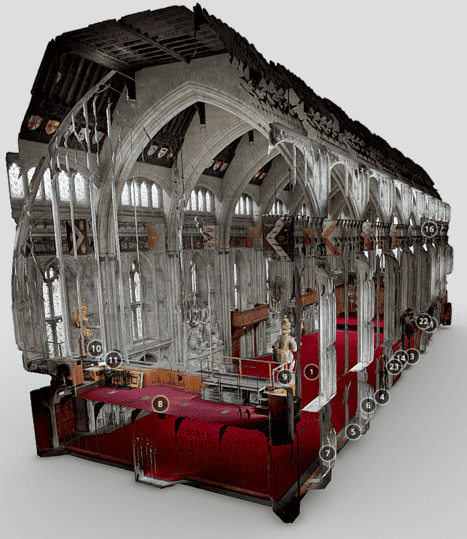
As a Gresham College professor since 2005, and an Honorary Life Fellow, I was thrilled to hear that you’ve been frequenting Barnard’s Inn Hall these past few days. At Gresham we cover a huge range of topics in over 140 lectures a year. We once used advanced statistics to craft the best Gresham lecture title ever, the one that would pull the big crowd. What we got was “London’s Dickensian Century of Modern Imperial World War Music Mathematics”.
To me Dickens is about wry humour and the boundaries of prose and verse. Dr David Bramwell, creator of the Cheeky Guides series, shares a wonderful story of posthumous humour from the 1980’s:
“The theatre director and comic actor Ken Campbell was well known for putting on plays up to 24 hours long. So when, in 1980, the Royal Shakespeare Company (RSC) put on an 8-hour version of Nicholas Nickleby, he felt they were stepping on his turf. While the play’s producer, Trevor Nunn, was on holiday, Campbell forged a letter from the RSC stating that the success of Nicholas Nickleby had been so great, that they would now be known as the RDC – the Royal Dickens Company. This letter was sent out to hundreds of people and posters for an upcoming version of Little Dorrit were put up. People were writing to the RSC responding to invitations to take part in the new play or expressing their indignation that the RSC was shutting down. When Nunn got back from holiday he was so angry he set up a police investigation. Campbell finally came clean on Newsnight, but never apologised; he maintained he was doing it to highlight the great work of the RSC.”
Two other topics have been very high on the news charts for the past year. Artificial Intelligence and the Ukrainian war. These two have come together in a new Russian AI export, ChatKGB – “the computers ask the questions to which we humans are forced to respond”.
I wondered what Dickens might make of both AI and the Ukrainian war. Let’s start with AI. The comedian Steve Wright once asked, “If you had 1,000 Shakespeare’s, could they write like a monkey?” To paraphrase Steve, “if you had 1,000 Dickens could they write like an AI?”.
I couldn’t resist asking ChatGPT “what funny thing would Charles Dickens say about artificial intelligence?” The response was – “Artificial intelligence is the duffer sportsman of science, whose performance never matches its promise.” Not bad.
On Ukraine, did Dickens ever speculate that the Crimean War might never end? For another author, speculative fiction writer Jasper Fforde, the Crimean War never ends, continuing for some 169 years, spanning some seven books, in Fforde’s Nextian Universe.
Dickens was not directly involved in the Crimean War, but was very critical of the government’s mismanagement of the war, especially the poor conditions and lack of supplies for the British soldiers. He expressed his views in his journal Household Words, where he published articles and stories that exposed the incompetence and corruption of the bureaucracy and the military. In 1855 he created a satirical representation of the government in Little Dorrit, the Circumlocution Office, a fictional department notorious for its red tape, delays, and obstruction of any useful public service. Dickens felt that bureaucratic indolence and inefficiency were responsible for the sufferings of British soldiers in the Crimean War, as well as for many other social problems. His pen, as ever, was his weapon to attack the system and call for reform.
For me, Dickens is about humour and poetry in daily life, enlisted in the earnest purpose of reform.
In the Pickwick Papers, Mr Snodgrass defines poetry – “Poetry makes life what light and music do the stage.” William Wordsworth says poetry is “emotion recollected in tranquillity”. I think that elegantly describes Dickens approach too, the emotion of life recollected in tranquil prose. Dickens focused not on form, but always on what works. As a journalist he would have loved Ezra Pound’s definition of poetry as “news that stays news”, yes even while writing freshly, Dickens was careful not to get too drawn in too deep by contemporary topics that would chronologically lock him into Crimea or AI or any other rapidly moving subject. Despite being a journalist he stuck as much as possible to timeless themes and subjects surrounding the human condition.
Though “The Ivy Green” and some other verse were popular, Dickens watched his pennies and would have taken great heed of Don Marquis’ assessment of poetry’s commercial potential – “Publishing a book of poetry is like dropping a rose petal down the Grand Canyon and waiting for the echo.”
The greatest thing about Dickens is his accessibility. We can see the good old days through the lens of London and realise that the best thing about the good old days is that they were neither wholly good nor old, but eternal.
In Nicholas Nickleby, the old gentleman raises his voice saying, “Bring in the bottled lightning, a clean tumbler, and a corkscrew.” I say, please raise your glasses, stand, and join me in a toast to “The Immortal Memory Of Charles Dickens”!
NOTES:
Naturally, the image for the article was produced using ChatGPT.
Proceedings – https://www.proquest.com/openview/0a566fd8926ebf252b88a04da282b7a3/1?pq-origsite=gscholar&cbl=406312 – Annual Conference of the Dickens Fellowship: Barnard’s Inn, London (26-29 July 2023)
Siddoway, Deborah. The Dickensian; London Vol. 119, Iss. 520, (Autumn 2023): 240.
Coverage – https://dickensfellowship.org/index.php/announcements/300-2023-dickens-fellowship-conference