
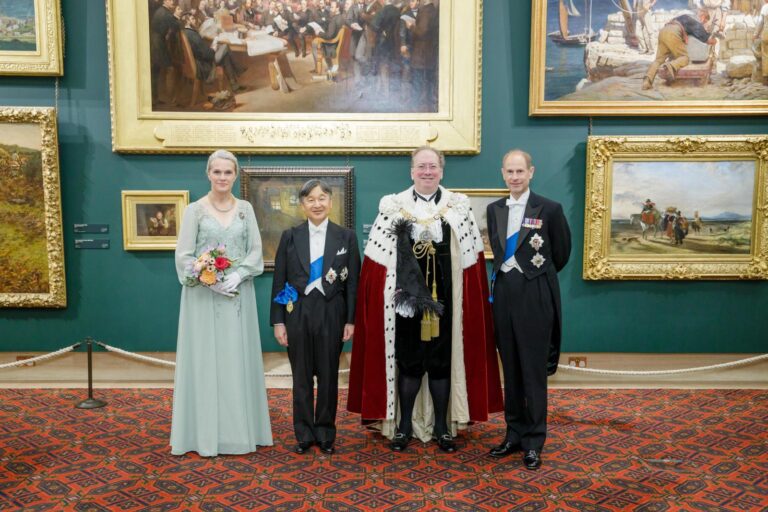
To get a second state visit is a real honour, and even more meaningful given my family’s four generation deep connections to Japan. My remarks to:
Your Majesty. Your Royal Highness. Your Excellencies. My Lords. Aldermen. Sheriffs. Chief Commoner. Honoured Guests.
Konbanwa. Good evening.
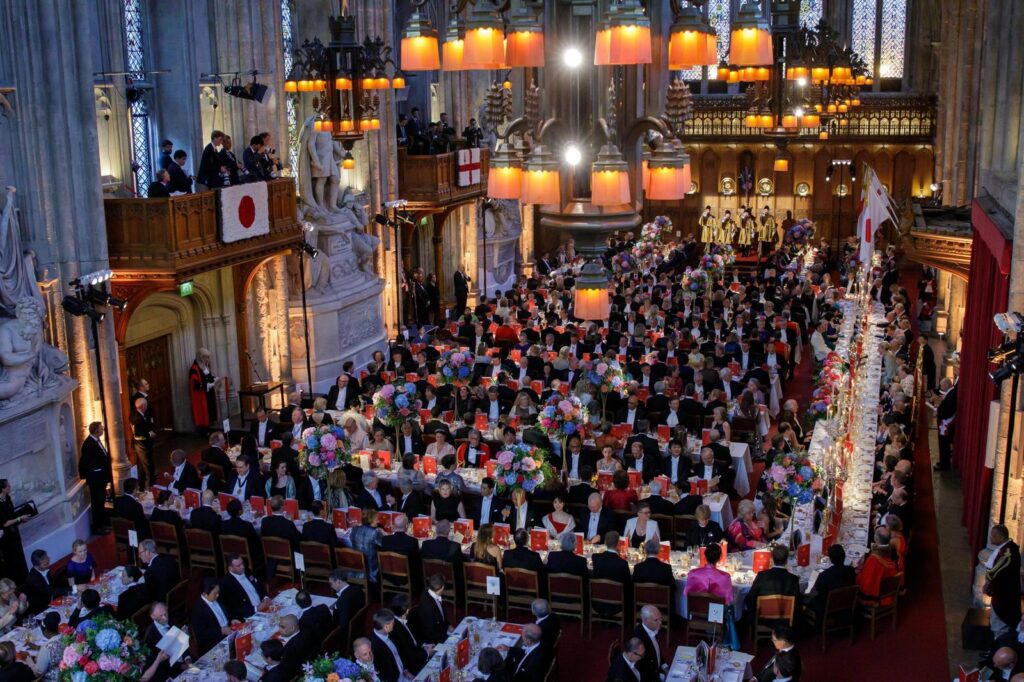
As the 695th Lord Mayor of London it is an immense honour to welcome you to Guildhall this evening, Your Majesty, and to present to you the Address of Welcome, which conveys our esteem for Japan. The Lady Mayoress and I were privileged to join you and Empress Masako at the State Banquet hosted by Their Majesties The King and Queen at Buckingham Palace last night. And it is our pleasure to be joined this evening by His Royal Highness The Duke of Edinburgh.
Your Majesty, I know that you have strong personal connections to the UK, having studied the history of cargo-carrying on the Thames at Oxford University, and even titling your memoir – The Thames and I – after London’s iconic waterway. To quote Sir Winston Churchill – whose statue sits just over there – the Thames is “the silver thread of our nation’s history”; a vital trade artery around which this great City was formed.
As you say in your memoir, Your Majesty, the Thames is a “necessary, vital element in the London scene.” If I write a memoir, it will record that for over two decades the Lady Mayoress and I undertook the restoration of the cargo vessel, SB Lady Daphne. And, this mayoral year, we’ve reinstated the historic offices of the Water Bailiffs, restarted the Lord Mayor’s view of the London Stones, and, in September, we will hold our first ‘Thames Day’ as part of World Rivers Day. So, you see, Your Majesty, we in the City fully understand why you would choose to spend your time in the UK visiting the Thames Barrier!
In turn, Your Majesty, we have strong personal links to your great nation. I studied East Asian history under Edwin O Reischauer, the former United States Ambassador to Japan. Four generations of Mainellis have lived in Japan. Today, my son is just one of three million foreign nationals living in Japan, 20,000 of whom are Britons – living with his wife and my grandsons in Yokohama.
Our two nations complement each other like sun and water. Halfway across the planet from one another, our comparative advantages are ideas and innovations, not heavy goods and commodities – concentrated ‘knowledge products’, like microchips. Over the years, the UK has readily adopted many aspects of Japanese culture, from anime, karaoke and karate to ramen, matcha and mochi.
In turn, we’re thrilled that several iconic British products have been granted a special protected status in Japan, such as the London Cure Smoked Salmon and Scotch Beef we’ve enjoyed this evening! The London Symphony Orchestra – which is based at our very own Barbican Centre – has made regular tours to Japan since the Sixties. And Elisabeth and I are getting into Japanese zither music.
Partners in the G7 and the Comprehensive and Progressive Agreement for Trans-Pacific Partnership, Japan and the UK are each other’s most important allies in Asia and Europe respectively. Japan was the first country the UK signed a Free Trade Agreement with when we left the European Union. And the Hiroshima Accord will only deepen that relationship in areas like defence and renewable energy.
Our global financial centres, Tokyo and the Square Mile, are flourishing thanks to the Memorandum of Understanding signed by the Tokyo Metropolitan Government and City Corporation in 2017, the impact of which was evident during my visit to Japan last month, where I had the pleasure of hosting a press conference and bilateral meeting with Tokyo’s Governor Koike, and discussed opportunities for further collaboration in asset management, fintech and green finance.
Friends, The City of London,, to which I affectionately refer as the world’s oldest democratic workers’ and residents’ cooperative, is – rightly – known for its professional and financial services. But the Square Mile contains many more areas of expertise – ‘Knowledge Miles’ – which are equally essential for global prosperity. From the 15th century New Learning, to 16th century Gresham College, to the 17th century Royal Society, our City is a timeless home for global innovation. Indeed, in 1863, five young Japanese noblemen came to our City, the ‘world’s coffee house’, to study analytical chemistry at the University College London. The Chōshū Five, as they were known, would go on to become the makers of modern Japan. Today, the City is home to 40 learned societies, 70 higher education institutions, and 130 research institutes, with a workforce that includes significant numbers of scientists, engineers and technicians.
Speaking here at Guildhall in 1971, Emperor Shōwa, praised the “quiet but effective collaboration between the scholars, scientists and technical experts of [our] two countries.” Fifty years on, and the problems facing the world today have evolved, but the willingness of our scholars, scientists and technical experts to work together to tackle them is unchanged. Something you remarked upon at Buckingham Palace last night, Your Majesty, and witnessed first-hand today during your visit to the Francis Crick Institute, which supports an innovative Japan-UK research partnership covering a range of public health issues.
Fun fact: the quality of joint UK-Japan research is four and a half times the world average! Current geopolitical and technological trends render coordinated action even more necessary.
So, we welcome Japanese support for our ‘Connect To Prosper’ theme, which seeks to leverage the power of the City’s unique connections to tackle global challenges,, and promotes international standards that provide stability and security.
Our six initiatives are: The Ethical AI Initiative, through which 30 countries have signed the “Walbrook AI Accord”, emphasising the application of ISO 42001…and 5,000 people, from over 50 countries including Japan, have taken one of our ethics courses for AI professionals; Then there’s the Space Protection Initiative, which aims to keep space clean using space debris removal insurance bonds; The Green Finance Initiative to reinforce carbon markets, on which our Policy Chairman, Chris Hayward, leads; The Smart Economy Networks Initiative, using international X-Road standards; The Constructing Science Initiative, for life science laboratories; and GALENOS, to accelerate global mental health research, working with Oxford University and the Wellcome Trust.
Sir Walter Raleigh said “there are two things scarce matched in the universe – the sun in heaven and the Thames on earth.”
This quote is pertinent tonight because it contains symbols of both Japan, and the UK. The silver thread of the Thames, connecting us. The sun representing Japan, Nippon, Land of the Rising Sun. Our nations complement and support one another and, to paraphrase Raleigh, our close and deep friendship is “scarce matched in the universe”.
Domo arigatou gozaimasu. Thank you.
May I now invite everyone to rise for the National Anthem of Japan, after which I will propose the toast to The Emperor. The toast is: “The Emperor of Japan!”.
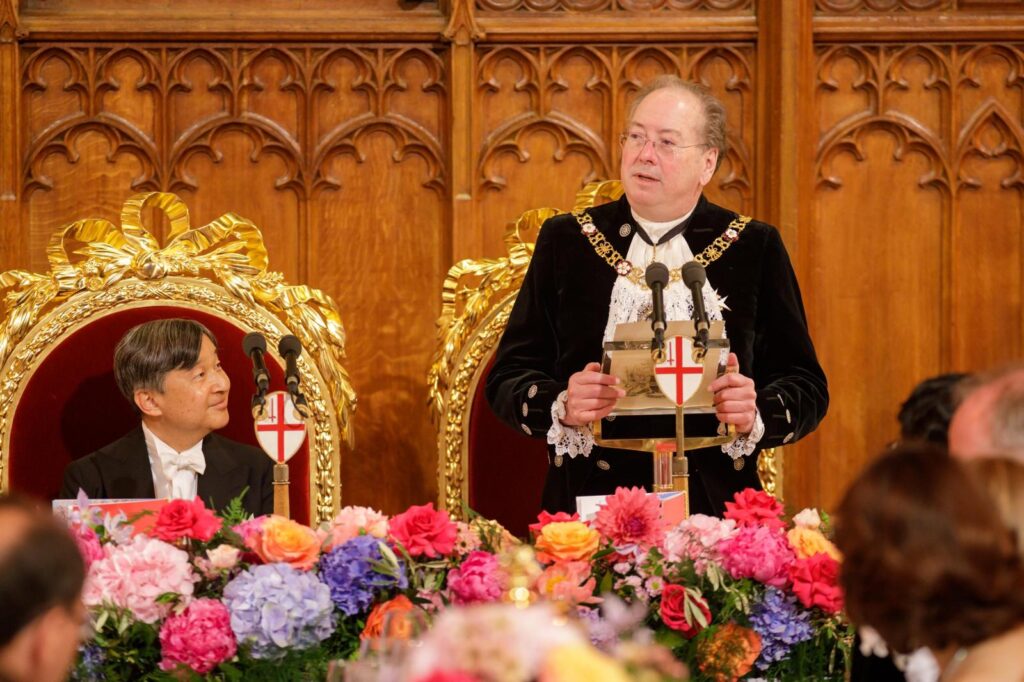
Japanese State Banquet closing remarks
Honoured guests. Thank you, once more, for being here this evening. And thank you, Your Majesty, for your kind words about the City and the UK.
I wasn’t too sure whether to share an intimate story with such a large audience, but, after hearing your own tales of the kindliness of British people, I want to tell you about a moment of goodwill from my very first trip to Japan in the early Eighties, around the time you were studying in Oxford, Your Majesty.
As tourists do, I decided to visit an onsen – a traditional Japanese bathing facility. I’ll admit I was quite anxious about observing proper etiquette. Noticing this, a Japanese man who was at least eighty years old approached me and – unblinking, and without any kind of judgment – demonstrated how I should wash myself. The poignancy of the moment was undiminished by the fact that we were both, shall we say, completely and utterly disrobed!
Like you, Your Majesty, I have never forgotten the kindliness I was shown. To finish, I’d like to share a haiku by a great poet of the Edo period, Yosa Buson (1716-1784):
The light of a candle
is transferred to another candle –
spring twilight.
It puts me in mind of a quote, by Thomas Jefferson (1743-1826): “He who receives an idea from me, receives instruction himself without lessening mine; as he who lights his taper at mine, receives light without darkening me.”
This concept, that one candle or taper can light another without being diminished, serves as a symbol of the precious, symbiotic relationship between Japan and the UK. A relationship based on a shared love and exchange of knowledge. Like twin flames glowing brighter and brighter, when we connect, we will prosper.
Thank you.