Gresham College – A Short, Personal, Alternative History

Gresham College – A Short, Personal, Alternative History

 Professor Michael Mainelli, Gresham Fellow & Trustee
logo_sq_crest+text_large

[October 2009 – originally written for the Mercers’ Company]

Sir Thomas Gresham (1519-1579) traded cloth and linens between England and the Low Countries at a time when Cambridge and Oxford had a duopolistic hold on higher education in England.  A Cambridge man himself (Caius College), if Gresham’s skippers had visited an Oxbridge College they would have, at best, had the door of a college opened to them and then been laughed at in Latin for their ignorance before being closed in their face.

If you’re going to backstab some one properly, do it from the front. Gresham did so with money. Sir Thomas died of apoplexy in 1579 bequeathing one moiety to the Corporation of London and the other moiety to the Mercers’ Company, charging them with the nomination of seven Professors to lecture in Astronomy, Divinity, Geometry, Law, Music, Physic and Rhetoric.  He required the lectures to be in Latin and, horror horribilis, English.  In effect, Sir Thomas, who pursued monopolies himself, used his will of 1575 anti-monopolistically to crack the Oxbridge oligopoly by bribing seven professors to give lectures to the public, in English.

Gresham College is about ‘new learning’.  Sir Thomas felt strongly that the ‘new learning’ should be available to those who worked – merchants, tradesmen and ships’ navigators – rather than solely gentlemen scholars.  In the 17th century, the Royal Society was founded to explore “natural philosophy”, new learning through experimentation.  So, it is no surprise that the Royal Society was founded and housed at Gresham College for half a century (1660 to 1710) and numbered among its associates Gresham Professors Petty, Boyle, and Evelyn.

For over 400 years the Gresham Professors have given free public lectures in the City of London.  I had the privilege of four years (2005-2009) in the modern, eighth chair as Mercers’ School Memorial Professor of Commerce from 2005 to 2009.  There are some deep footsteps in which we tread.  Early professors at Gresham College included Christopher Wren and Robert Hooke, also integral to the Royal Society.  Recent professors include the mathematical physicist Sir Roger Penrose of Penrose/Hawkings fame and the theoretical physicist John Barrow, who won the Templeton Prize and the Royal Society’s Michael Faraday Prize.

Professorships are awarded for three years with a stipend for six lectures a year, though professors often give more.  Each professor develops his or her own programme.  Academic professors complain that what seems like a sinecure is actually a very demanding post requiring novel, innovative, researched lectures of six to eight thousand words suitable for a global audience.  Business professors, such as I, definitely find it is work.  My estimate is that each lecture takes approximately 100 hours of preparation, thus 600 hours at about £10/hour – you’re not doing it for the money.  In fact, at that rate you should question whether you’re competent to be a professor of commerce.

As my tenure was extended for a year and I had ‘been volunteered’ each year for an additional lecture in the Docklands, I gave 28 lectures.  As a glutton for work, I gave a final synthesis lecture as part of the City of London Festival’s celebration of the 2,000 anniversary of the publication of Ovid’s Metamorphoses with saxophonist John Harle and friend Bill Joseph, “Metamorphoses: The Terrible Beauty of Change“, for 29 formal lectures in four years. The core 28 lectures, around 8,000 words per lecture, 56,000 words per year, some 224,000 words, found their way into the obligatory book – The Price of Fish: A New Approach To Wicked Economics And Better Decisions.  Fortunately for readers, only 100,000 found their way out to the printer.

Given 48 professorial lectures a year, along with honorary professors, former professors, fellows and numerous guest lecturers, Gresham College provides around 140 intellectual events a year for business people, retired people, mature students, university students, schools and the general public.  Each year over 20,000 people physically attend Gresham College’s 140 lectures.  In an age concerned with making money from intellectual property, Gresham College encourages the free exchange of ideas and is one of the most potent intellectual houses on the net and podcasts.  To quote Jefferson, “He who receives an idea from me, receives instruction himself without lessening mine; as he who lights his taper at mine, receives light without darkening me”. The Gresham community worldwide downloads lectures over a million times each year from a library of now thousands of recorded lectures, many of which find their way into syllabi from the USA to China.  My strapline for Gresham College today is, “Gresham College: The Modern Tudor Open University”, a “Tudor TED” even.

At Gresham College, we seek to reinterpret the ‘new learning’ of Sir Thomas’s time in contemporary terms.  Our emphasis is on sharing knowledge, exchanging ideas, fusing old views and generating new insights.  Gresham College is increasingly important for those living and working in London as the traditional universities and colleges focus on qualifications and are less able to offer the extra-mural activities they once did.  We have no conscripts: we have a community of people who come because they want to, because they find the lectures and seminars topical, informative and enjoyable. Gresham College is about personal, higher education from dipping into one lecture to completing a series.  I often lord over my academic friends that our current Registrar continues a long tradition of Registrary excellence – in over 400 years no registrar has admitted a single student.

Yes, I am a Gresham Groupie. I found the four years at Gresham College extremely rewarding and remain a Trustee and Fellow, and my firm continues to work on Long Finance and the London Accord with Gresham College.  Sir Thomas Gresham is synonymous with Gresham’s Law, best expressed as “good money drives out bad”.  I often think that the best people in the world come to work in one of the best cities in the world because Gresham College has a part in helping good discussion drive out bad.  Our 16th century Open University is going strong in the 21st.

[I continued to give talks and run symposia to the point that I ultimately became involved in over 120 events.]

To view all Michael’s Gresham lectures.
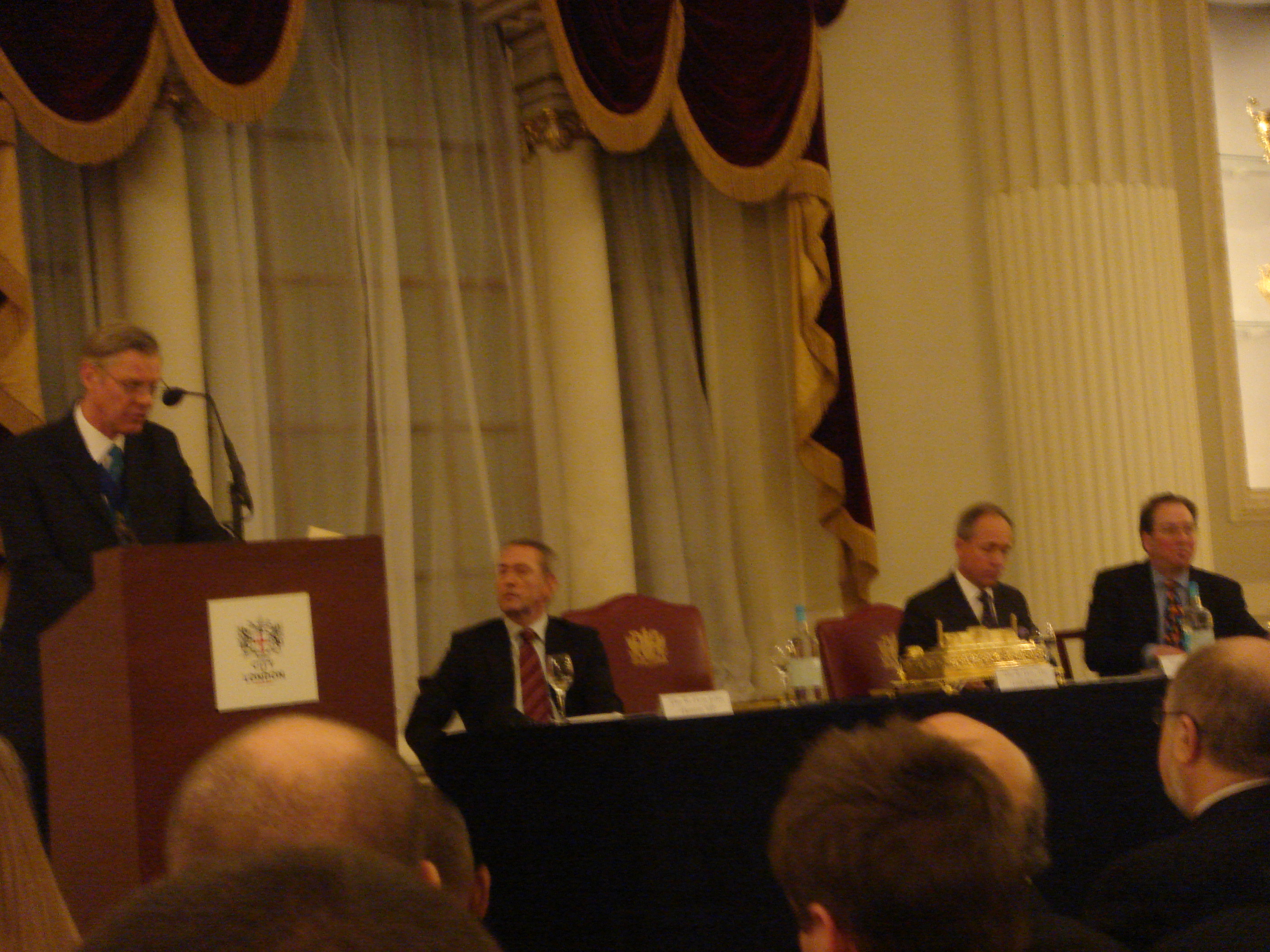
The City Debate: In This Current Financial Environment, More Financial Regulation Is A Major Part Of The Solution

Securities & Investment Institute
Annual Debate
Mansion House, London
Wednesday, 14 January 2009

“In this current financial environment, more financial regulation is a major part of the solution”


For the motion:
Dr Vince Cable MP
Mr Alan Yarrow FSI

Against the motion:
Professor Michael Mainelli FSI
Mr David Bennett FSI
Chairman – My Lord Mayor, Ladies and Gentlemen.

Chairman:
Mr Christopher Jones-Warner FSI

Continue reading

London Accord – Sharing Research To Save The Planet

After two years of hard work led by Jan-Peter Onstwedder and me, we finally launch the London Accord at Mansion House on the evening of 19 December.

Grainy but true – l to r: Rt Honourable Lord Mayor David Lewis, Rt Honourable John Sutton MP, Sir Michael Snyder, Professor Michael Mainelli

My Lord Mayor, Your Excellencies, My Lords, Secretary of State, Alderman, Sheriffs, [Councillors, Distinguished Guests,] Ladies and Gentlemen… – it is my great pleasure to have this opportunity to tell you tonight about the London Accord.

The London Accord’s theme is “cash in, carbon out”. The London Accord provides informed views about climate change investment and sets out a methodology for evaluating those investments. The London Accord began in 2005 at almost the same time as the Stern Review. Sir Nicholas said last year that “climate change is the greatest market failure the world has seen”. While I admire many aspects of the Stern Report, I beg to differ with this specific point.

Continue reading

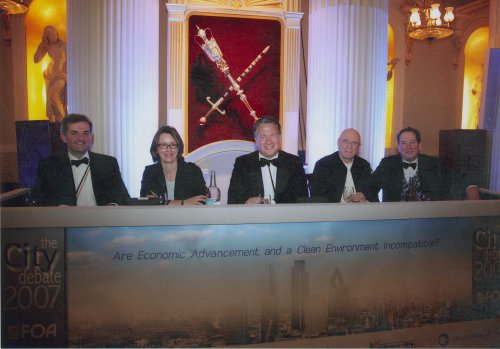
The City Debate: Are Economic Advancement & A Clean Environment Incompatible?

The City Debate 2007 at Mansion House, 29 January 2007

[left to right]

Chris Huhne MP (Liberal Democrats’ Shadow Environment Food and Rural Affairs Secretary), Emma Duncan (Deputy Editor, The Economist), Rt Hon Michael Portillo, Richard D North (Fellow, Insitute of Economic Affairs), Professor Michael Mainelli (Executive Chairman, Z/Yen Group)

The somewhat awkward motion was “Green and Growth Don’t Go” (together implied) though the invitation was “Are Economic Advancement and a Clean Environment Incompatible?”. The audience was over 300 people from finance.

Professor Michael Mainelli’s opening statement to engage the audience was:

Chairman – My Lord Mayor, Ladies and Gentlemen.

Anyone with a waistcoat like mine knows that Green and growth don’t go together. Tonight I am that kid who told you that Santa Claus didn’t exist. Green and growth is a lie-for-children alongside Santa Claus, the Easter Bunny, Nessie, immaculate conception, intelligent design and honours-on-merit.

Let’s face one inconvenient truth – this spinning rock we live on is currently over-run by a bunch of trumped-up naked apes who have three primate imperatives:

  1. find bright, shiny fruit;
  2. avoid snakes;
  3. if you see someone attractive, let them know in a totally satisfying way that you find them attractive.

Three simple imperatives have led to 6.5 billion of the pests monkeying with the world’s thermostat. Way up in the white ivory trees, some brainy apes don’t fulfil imperative three very often. These apes sublimate their urges by dreaming up theories. Their current brainy theory: the moist fringe of this spinning rock is getting all steamy.

Do we know that CO2 levels are rising? Yes. Is there is a credible theory of global warming? Yes. Does this imply big changes over the next century? Yes. So what’s to debate? Well, other brainy apes down on the jungle floor sublimate their urges playing trading games and inventing theories about alpha returns. Jungle-floor apes have a theory: global warming can be stopped if everyone changes their economics a little bit. However, preventing global warming requires massive changes in economics and human nature within this decade, and human nature won’t change in time.

At Mansion House we can debate with real numbers. This is the City, not Westminster.

In 2004, gross worldwide emissions were about 7bn tons of carbon. Emissions are projected to grow to 14bn tons by 2054. For long-term stability, emissions in 2054 must be at or below today’s 7bn tons, and decreasing. Green and growth fans need a 7bn ton cut from “business as usual” by 2054. Socolow at Princeton identified 15 reasonable opportunities, called “wedges”, that would each cut 1bn tons by 2054. One wedge – convert 250 million hectares to biofuels, 1/6th of the world’s cropland. Another wedge – 2 million wind turbines on 30 million hectares, a Germany of wind turbines. Remember we need at least seven of these megaprojects in the next 47 years. They’re very realistic plans. Each wedge costs more than the GDP of China.

Global GDP was $44 trillion in 2005. Stern expects people to pay $440 billion each year to prevent climate change, $125 billion in the USA, $20 billion per annum in the UK. Starting this year. And the CO2 will still exceed 500 ppm. This is incredible, by which I mean it’s not believable. I don’t want a repeat of my Westminster experience on Nuclear Electric decommissioning. “Yes Minister, that number is possible, but certainly not probable!”

The UK has 1% of world population, but emits 2.2% of greenhouse gases. The FTSE 100 alone produce 1.6% of global greenhouse gases. The average person in the UK produced as much CO2 by 6 January as the average person in the world’s poorest countries will all year. You really think this will change?

We are natural optimists in the City. We want to believe that we can do good; we can be green; the bad are punished and the good are rewarded; every story has a happy ending. We fixed the ozone layer; we handled sulphur dioxide well. But these weren’t 50-year, $22 trillion problems. You’ll point to emerging carbon markets we’d all love, but right now carbon credits are little different than the Catholic Church selling indulgences. And that leads us to human nature – sex, greed, fear and apathy.

We breed. By 2054, there will be 9.5 billion of us. Even if Britain stopped all GHG emissions, within two years China’s growth makes that effort worthless. What’s the point if Brazil, India, Russia and China just keep going?

Sure people care but CO2 is tasteless and odourless, while I must have missed seeing us stop a million children a year dying of preventable HIV and measles, 1 million of malaria, 1.5 million of diarrhoea? We are going to solve global warming, yet let 2.7 billion people live on less than $2 a day? Even Stern had to cook the discount rate to make global warming a better investment than the UN’s Millennium Development Goals.

If you believe that green and growth go together:

  • you believe that population will painlessly stop growing;
  • every Briton will pay at least $333 each year forever to prevent global warming, or perhaps $850 or more;
  • two centuries of high latitude infrastructure will be replaced, we will transform the UK’s £4 trillion housing stock – you’ve mothballed listed buildings such as this magnificent house;
  • you’ve stopped funding all oil exploration projects – what’s the point? If we burn what we already have we exceed 1,000ppm;
  • you’ve shorted most of the FTSE;
  • you’ve given up skiing and holiday in Croydon.

Our distinguished journalist will be erudite and persuasive, coming from a magazine with a readership determined to make money out of any investment fashion, a magazine that thinks invading Iraq was a good idea

After her you’ll hear from a gifted Westminster speaker who loves another excuse for them to raise taxes from us. Our speaker’s party peddles a real whopper for children – more tax is good for you and good for the country.

Human nature means that green and growth don’t go together, whatever lies for children politicians and journalists want to sell. Let’s be The City and tell it like it is. You must vote for the motion.

Thank you.

Result:

Debate This House believes that Green and Growth Don’t Go

Pre Vote

  • Yes 32
  • No 65
  • Undecided 3

Final Vote

  • Yes 41
  • No 58
  • Undecided 1

Yes, Michael and Richard won.

Additional Motions:

This House believes that the answer to climate change is technology and not restraining consumer demand

  • Yes 54
  • No 40
  • Undecided 6

This House believes that going nuclear is the answer to going green

  • Yes 57
  • No 35
  • Undecided 8

This House believes that US policy is the biggest single problem to combating climate change

  • Yes 63
  • No 36
  • Undecided 1