
JOINT LUNCHEON Remarks to:
Worshipful Company of Tax Advisers
&
Worshipful Company of Makers of Playing Cards
Professor Michael Mainelli
Thursday, 30 July 2026
Dyers’ Hall
Masters, Wardens, Members, Guests,
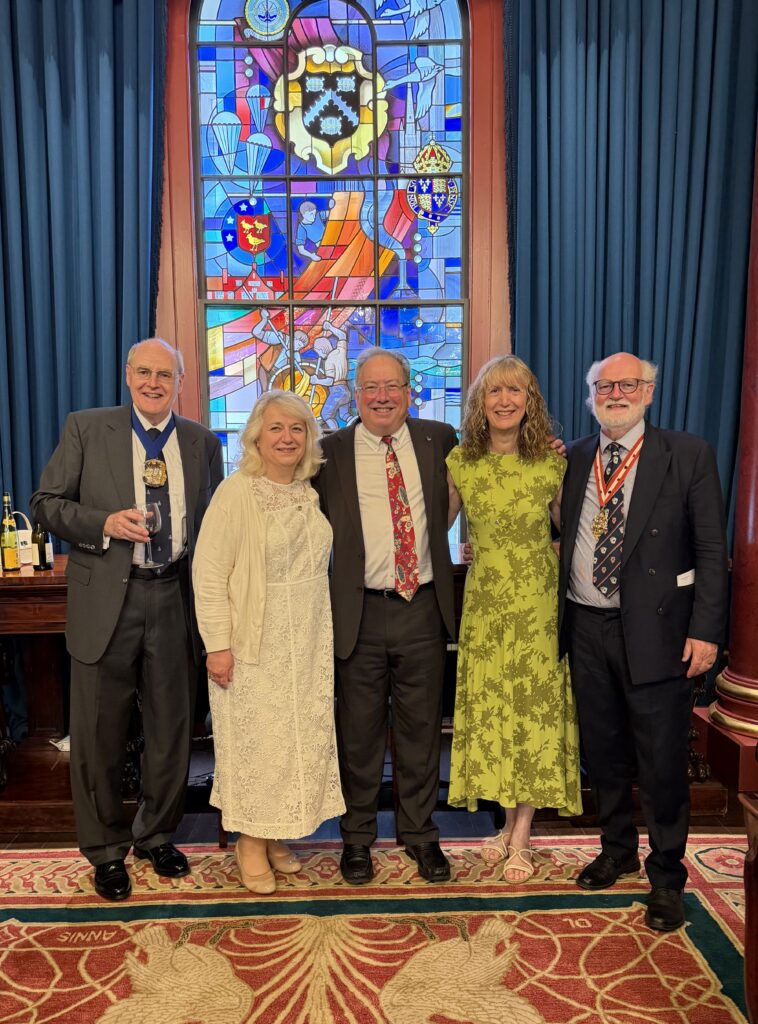
I am delighted to be among friends: Masters Matt Peppitt and Nick Prentice, both of whom I trust implicitly, though I would still cut the cards and check the small print. And Clerks Annie Prouse and Robert Lowth, without whom neither Company would function. Among tax advisers and card makers, I’m not sure whether I’m here to play by the rules, or to exploit them.
A joint member at a joint luncheon I’ll quickly share joint credentials. My French son once won the South-East France Tarot Championship, so our family plays Tarot, a medieval northern-Italian game. It can be rather dangerous – Steven Wright boasted: “I stayed up one night playing poker with tarot cards. I got a full house, and four people died.”
And as an accountant, I love cunning tax schemes the way other people love crossword puzzles. John Maynard Keynes praised such enthusiasm, saying, “The avoidance of taxes is the only intellectual pursuit that carries any reward”. These days ask an AI to explain tax law and it will say: “It depends.” So it’s clearly learning from the best.
Tax and playing cards have long been intimate companions. The government placed a fee on packs of cards from at least 1588. The “Duty Ace” of spades, “Old Frizzle”, is an elegant tax stamp. Every hand dealt delights the Treasury. As for evasion, even royalty was in on it — Rycote Chapel’s ceiling of gold stars is cut, so the legend goes, from the King’s own playing cards.
So Nick and Matt thought it fitting for the City of London’s two most intelligent Companies to assemble and address an issue touching us as intimately as tax touched those old card decks: Artificial Intelligence.
“AI” existed quietly, for decades, until on 30 November 2022 ChatGPT brought it abruptly into public life – so much so that today AI is inescapable, from the media to pub chats to livery luncheons. The Turing Test was blown aside and now we struggle less with what AI is, and more with what we are.
What is new is not particularly the algorithms, but everything around them: chips fast enough to run them, connectivity cheap enough to feed them, energy abundant enough to power them, and, above all, volumes of data — vast data, harvested from every card game, every tax return, every one of us. AI is not one invention. Algorithms have encountered decades of infrastructure improvements arriving all at once.
LLMs don’t ‘think’ in any human sense; they predict the next plausible token. In cards, probability matters. In AI, probability is the game. We shift from “designed intelligence” to “emergent intelligence”, from careful architecture to something closer to primordial ooze.
And because AI looks like magic, it invites — and here I use a word that jars slightly — cheating. Cheating at cards is an old, almost honourable sin. Cheating on your tax return is an even older, almost honourable sin. AI offers entirely new ways to cheat at both — and entirely new ways to be cheated. AI doesn’t just play the hand, it reshuffles the deck while we’re still bidding. So how do we align AIs with human values? I contend there are two ways – top-down outside-in, or bottom-up inside-out.
We old-time researchers from long ago saw ethical AI problems coming, so much so that we engaged the International Standards Organisation formally in 2017, leading in 2023 to a top-down outside-in international standard of the kinds we have for shipping, food safety, or aviation.
As Lord Mayor, tens of nations signed the Walbrook Accord two years ago at Mansion House. 50,000 people worldwide took our ethical AI course. The Accord backed the international rollout of ISO 42001, the AI management-system standard, and its European companion EN 18286, such that firms such as Microsoft, AWS or KPMG are now independently certified. Along with about 70 other nations, the UK formally endorses ISO 42001. Top-down outside-in beloved by accountants, regulators, and lawyers – tick, tick, tick, here’s your certificate.
But top-down outside-in only gets you so far, which is why our current work at Ordinary Wisdom (www.ordinarywisdom.ai) takes the opposite route — bottom-up, inside-out. Instead of policing AI’s outputs after the fact, we try to encode whose values it should hold dear before it opines on anything. It is the difference between confiscating marked decks at the door or teaching every player, human or machine, to play fairly for the sake of the game. We are trying to give AIs a conscience – behaving properly even when no-one is looking.
Consider Bridge – DeepMind and other AIs beat world champion Bridge players, yet never experienced the mild thrill of a successful bluff or the mild horror of a partner’s eccentric bidding system. Consider tax. The good news is AI might simplify tax. The bad news is AI might understand it. Tax advisers used to look for loopholes. AI now suggests them faster than legislators can close them. But AI lacks judgement and ethics – the subtle navigation between avoidance and evasion, between compliance and conscience. “Yes, this is legal—but is it right?” Whose values? What goals? Who controls? And who audits the auditors when they are machines?
Theologians and philosophers have argued for millennia about what makes us human — reason, soul, conscience, love, the capacity to bluff convincingly at cards. Those ‘why do we exist’ questions used to be comfortably abstract, light exchanges for people exactly like us, after exactly this sort of lunch. AI makes questions of existence urgent, daily, and unavoidable.
Cards are about uncertainty, probability, and bluff. Tax is about certainty, rules, and—occasionally—bluff. Both require judgment under pressure and imperfect information. Both reward those who understand not just the rules, but the values of the people around the table. With people, no AI can be as smart as a vicar. A vicar took a phone call from HMRC looking into the tax affairs of one of his parishioners. HMRC asked, “did he really donate £25,000 to your church?” The vicar replied, “he will.”
We face wider AI issues too, of concentration – power accumulating in the hands of a few companies, a few individuals, a few nations. AI’s appetite for water and energy is now a genuine planetary constraint; every large model you query drinks and burns more than you would like to know.
And gamification, amplified by machines that never sleep, never blink, and trade at inhuman speed: AI agents built to negotiate with other AI agents, on behalf of agents representing agents — or may I use a Terry Pratchett metaphor, ‘turtles’, a world standing on the back of elephants standing on a giant turtle, in turn on turtles standing on turtles all the way down, unsure which turtle, if any, is still based on something human.
Oh, and we may all be out of our jobs.
Which brings me to a word we rarely use at a Livery lunch: Adultery. Adultery is a fundamental breach of trust. It is the betrayal of an intimate, solemn relationship in favour of a cheap, transactional imitation. If we surrender our judgment, our ethics, and our critical thinking entirely to automated systems—if we pretend an algorithm can replace the deeply personal, moral duty of a professional to a client or a player to their peers—we are committing a form of intellectual adultery. We are cheating on our own humanity.
An old card player’s quip about relationships brings this home:
“Marriage, they say, is very much like a deck of cards.
In the beginning, all you need is two hearts and a diamond.
By the end, you just wish you had a club and a spade!”
The message behind that jest is simple: tools and rules are easy at the start, but long-term success requires managing complexity, conflict, and genuine human connection. As a recent papal encyclical on safeguarding human dignity expressed, AI brings into question what it means to be human. Not in some distant future, but here, now, in our daily work, leisure and discourse.
Benjamin Franklin famously said, “nothing is certain except death and taxes”. I’m not even sure what’s the big difference between death and taxes? I guess it might be that Parliament doesn’t meet every year to make death worse.
This is not advice for Matthew as he retires tomorrow … A scary, true story, in 2024 a friend asked AI to write his obituary. It did, exceedingly well, including his date of death. AI is getting up there with Death, the contemplation of our human mortality, as the bitter nugget that makes us savour life more. Our constant reminder to make the most of it, carpe diem, because tempus fugit, time flies.
We choose between the morbid Albert Camus, “The meaning of life is whatever prevents you from killing yourself.”
Or joyful Douglas Adams, “The answer to the ultimate question of life, the universe and everything is 42.”
If machines are smarter than us, what remains? If they can write, analyse, and even create—what is our role? I would suggest three answers:
First: we are the source of values. Machines do not originate ethics; they reflect and amplify ours. A programmed decision is not an ethical decision. An ethical decision may be to break the law.
Second: we are the arbiters of meaning. A perfectly optimised tax strategy or a perfectly played hand is meaningless without human context.
Third: whatever the outcome – we are the ones who must live with the consequences.
We are not being asked to out-calculate our machines. We are being asked to exhibit what they cannot calculate nor feel: nerve, judgement, and the occasional glorious, irrational bluff. AI is not just changing how we play the game—it is changing the game itself, and only human judgment will keep it worth playing.
There has never been a better time, nor a more frightening one, to explore what it means to be a human. Embrace it. Savour the terror. Because in the end, it is not the hand you are dealt – it is how humanly you play the game.
And on that note:
To aces high—and liabilities low.
To cards well played—and taxes well paid.
Would everyone who is able please rise and join me in a toast: To the joint Companies, may they flourish root & branch forever.
TO THE JOINT COMPANIES AND THEIR MASTERS!
Thank you.